The Templars today: the statute, the spirituality and the service of the “Minister Templi”
Excerpt
A new millennium began some years ago, and already the seeds of good and evil in perpetual struggle have taken shape. We remember the word of God at the beginning of human history, when the Lord addressed the treacherous serpent, saying: “I will put enmity between you and the Woman, between your offspring and hers; she will crush your head, and you will strike at her heel!” (Genesis 3).
Among the seeds of good, the courageous rebirth of the New Templars must undoubtedly be highlighted: “good” men of Christ who, with renewed evangelical vigor, are determined to return, more valiant than ever, to the battle of life to defend the faith, sow hope, and revive charity.
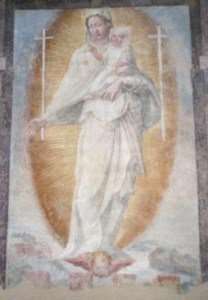
The Madonna of the Templars
“The signs of the times” show ever more dramatically and as a priority the missionary commitment to the proclamation, spreading and defense of the FAITH, consolidating its foundations and load-bearing pillars with an effective life and witness, giving the world back to God, and then, again strongly and primarily, with the human and Christian commitment to spreading CHRISTIAN HOPE in a world “sated and despairing”, and finally with the most urgent need for the WORKS OF MERCY against violence, injustice and death.
The humble and courageous Templars are called by the Church to serve on the front line in defense of the faith, in the battle of hope against the seeds of despair and sadness, in the practice of evangelical love so that Christ may reign among his disciples!
It is necessary, however, to “START AGAIN FROM CHRIST” and to “PUT OUT INTO THE DEEP AGAIN” as the Supreme Knight of Christ, John Paul II, planned for this new millennium, in order to respond to the “challenges” of the world with the primacy of God, of prayer, of the struggle against evil, of hope and of joy.
Templars, “LET US START AGAIN FROM CHRIST”! THE NEW MILITIA: SAINT BERNARD OF CLAIRVAUX AT THE ORIGIN OF THE TRUE TEMPLAR HISTORY.
SAINT BERNARD THE WHITE MONK
Saint Bernard, abbot of Clairvaux, was called “the white monk” not only because he wore a snow-white habit, but above all because, like the white knight of the Apocalypse, a figure of Christ, he was all fire of apostolic ardor, a dynamic and exuberant mystic who traveled through almost all of Europe, setting alight with his words the religious and social life of his time.
He was one of those gigantic and colossal figures who often dominate every vital sector of their age and sum it up in themselves, in their name alone, as in a perfect synthesis.
Saint Bernard was, in fact, the typical representative of the Middle Ages and of that medieval renaissance that prepared the new times.
Aristocrat, ascetic, monk, organizer and renewer of Benedictine monasticism, orator and philosopher, diplomat and mystic, most gentle poet and man of granite holiness, as well as shrewd negotiator of peace treaties and political expeditions, Bernard of Clairvaux is certainly a most interesting many-sided figure who stands out powerfully in the white granite of his cowl against the background of the great events that marked the life of the Church and of Christian civilization in the first half of the twelfth century.
The life and work of the great Abbot were indeed one great yearning for elevation, concord, goodness, unity; they were also an intense, inexhaustible activity that knew no rest for the good of the Church and of humanity, in the most varied forms of the spiritual life, of works of charity, in the field of culture and of social action itself.
Saint George and his Lady
A man of the cell, indeed, and a man of the court, Bernard was the unconquered champion of the rights of God in the life of peoples against the deviations of heresy, indiscipline, schisms and fruitless party struggles, aiming at the unity of Christian Europe against the dangers of Asiatic barbarism, and he saw in Rome and in the Papacy the fulcrum of this unity.
To fulfil so high an ideal he traveled through France, reached Germany, stayed in Italy, stirring the flame of an ideal strong in faith, charity, purity and Christian greatness, and this ideal was the dream of his whole life, the luminous goal of his arduous journey.


