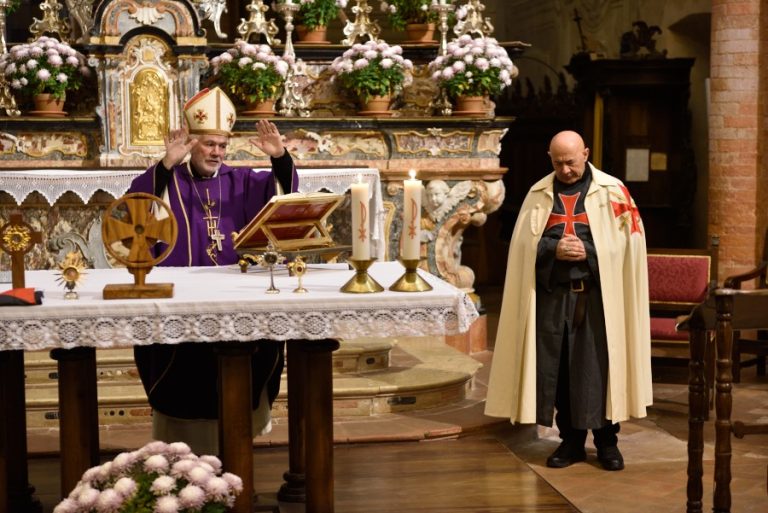
The Templar’s Vigil
In tradition, the Eight Nights of Tregenda correspond to precise dates of the year traditionally associated with dark rites, black rites and practices turned toward evil.
For today’s Templar these nights are not an occasion for curiosity, nor a moment to draw near to darkness in order to know it or experience it.
They are, instead, the moment in which the Christian Templar consciously chooses to keep watch and pray.
Ours is a form of combat, but not a combat made of weapons or violence.
It is a spiritual combat.
The Templar does not go out into the night to physically confront those who carry out these rites. That is not his task.
His task is much deeper: to oppose the works of evil through prayer, to ask God for protection for the victims and to plead for the conversion of the hearts of those who do evil.
It is precisely in this that Templar tradition identifies one of the highest forms of its own mission.
The Templar does not fight man as man.
He fights evil.
And he fights evil with the weapons that belong to the Christian Templar: faith, prayer, discipline, sacrifice and fidelity to Christ.
It is not, then, a presence against someone.
It is a presence in defense of someone:
in defense of the victims,
in defense of the innocent,
in defense of those who suffer,
in defense of those who are threatened by evil,
and even in favor of the redemption of those who have chosen the path of evil, so that they may convert and return to God.
“The light shines in the darkness”

The meaning of our vigil finds its foundation in the Word of Christ.
The Gospel of John opens with words that perfectly represent the meaning of our presence:
“The light shines in the darkness, and the darkness has not overcome it.”
(John 1:5)
This is the certainty that accompanies the Templar in the night.
We are not the light.
The Light is Christ.
We are men called to guard it, bear witness to it and carry it wherever darkness seems to have the greater hold.
And again the Gospel of John gives us the words of Jesus:
“I am the light of the world. Whoever follows me will not walk in darkness, but will have the light of life.”
(John 8:12)
For this reason, precisely on the nights traditionally associated with evil, we choose to gather around the Light.
Not to evoke the darkness.
But to pray that it may not prevail.
The Templar’s Vigil

The vigil belongs deeply to chivalric tradition.
The Templar was not merely one who fought.
He was one who kept watch.
He watched over the walls, over the weak, over pilgrims, over sacred places and over those entrusted to him.
The meaning of Christian chivalry therefore goes well beyond skill with weapons.
The Templar was called to place his own strength at the service of something greater than himself: God, justice, the defense of the innocent, the protection of the weak and fidelity to his own word.
Even today, when a Templar keeps vigil in the night, this ancient image takes on a spiritual meaning.
Our sentinel does not stand only before a gate.
It stands before the threshold between light and darkness.
And its principal weapon is not the sword.
It is prayer.
The Spiritual Combat

Christian chivalry has always also known the meaning of spiritual struggle.
The Templar may be called to fight, but even before that he is called to master himself, to remain faithful to his own word and to place his own strength at the service of good.
For this reason the Templar vigil does not consist in seeking confrontation.
It consists in standing before evil without allowing oneself to be transformed by evil.
This distinction is fundamental.
If we were to answer hatred with more hatred, violence with more violence, and wickedness with the desire to destroy the other, we would already have allowed darkness to enter our own heart.
The Christian Templar must instead remain steadfast.
He must be able to say:
I oppose evil, but I do not hate the man; I fight the sin, but I pray for the conversion of the sinner.
It is a struggle that requires discipline and faith.
In the Gospel of Luke, Christ himself reminds us that Satan’s kingdom cannot stand if it is divided against itself, and affirms that if demons are cast out by the finger of God, then the Kingdom of God has already come upon us.
This is the perspective within which we understand our vigil.
We do not oppose one darkness with another darkness.
We carry the Light.
We do not invoke evil against those who do evil.
We invoke Christ.
And we ask that His light may reach both the victims and the hearts of those who have become instruments of evil.
A Prayer for the Victims

During these vigils we gather to pray, above all, for those who are victims of evil.
For those who are persecuted.
For those who are abused.
For those who suffer violence.
For those who are killed.
For those who live in fear.
For those who are forgotten.
For all those who suffer the consequences of men’s hatred and wickedness.
Our prayer wishes to be a form of presence.
A silent presence, but not an indifferent one.
A presence before God to ask for protection, consolation and justice.
And We Pray for the Conversion of Hearts

But the Christian Templar cannot limit himself to praying against evil.
He must also pray for the conversion of those who commit it.
It is perhaps the most difficult part of our prayer.
Because praying for a victim comes naturally.
Praying that the persecutor lay down the weapons of evil requires, instead, a deeper faith.
Christ did not teach us to desire the perdition of man.
He taught us conversion, forgiveness and the possibility of a new life.
For this reason we ask the Lord to enter even the most hardened hearts.
We pray that those who do evil may recognize it.
That those who hate may return to loving.
That those who persecute may stop.
That those who have done evil may repent.
That those who have strayed from God may find their way back to Him.
This does not mean justifying evil.
The victim must be protected.
Evil must be stopped.
Justice must be respected.
But the Christian continues to believe in the possibility of conversion.
Our prayer does not ask for the destruction of the sinner.
It asks that the sinner may recognize evil, repent and return to the Light.
The Church and the Communion of Prayer

These vigils are not lived in solitude.
A priest is always with us and, often, a Bishop as well, so that our prayer may be fully inserted into the life of the Church.
We normally gather in a church, and often in ancient abbeys or consecrated places, where for centuries Christian prayer has left its own trace.
These are places where generations of men and women have prayed, celebrated the liturgy, called upon God, entrusted their dead and sought comfort in faith.
To enter these places during a night of vigil means to join, in spirit, that long continuity of prayer.
The stones of an ancient abbey are not merely stones.
They are witnesses of a faith that has crossed the centuries.
And we join, with humility, the prayers that have filled those places for generations.
We are not alone.
We pray together with the Church.
We pray together with the priest who guides our community.
And, when present, together with the Bishop who presides and blesses our prayer.
Our voice joins the voices of those who prayed before us.
The Heart of Our Vigil: the Holy Mass

At the center of our vigil we place what for the Christian is greater than any other form of prayer:
the Holy Mass.
For us there is no stronger rite.
There is no greater gesture than participation in the Sacrifice of Christ.
It is on the altar that our vigil finds its fulfillment.
It is before Christ that we entrust the victims.
It is before Christ that we ask for protection.
It is before Christ that we ask for the conversion of hearts.
It is before Christ that we ask for the strength to remain faithful to our vocation.
The night can be dark.
But on the altar Christ is present.
And Christ is the Light.
The Ancient Prayers of Christianity

During these vigils our prayer also gathers itself into the simple and ancient words that have accompanied generations of Christians.
The Our Father.
The Hail Mary.
The Glory Be.
Simple prayers, but profound.
Words spoken millions of times over the centuries.
And when they are recited in an ancient abbey, at night, they take on a particular meaning for us: our voice joins the voices of those who prayed before us.
We are not an isolated voice.
We are part of a communion.
A communion of faith, of prayer and of hope.
The Templar in the Night

Being a Templar today also means this:
being able to keep watch.
Watching when others sleep.
Praying when others have stopped praying.
Defending when someone is defenseless.
Remembering those who are forgotten.
Opposing evil without turning one’s own heart into another source of hatred.
And, above all, remaining faithful to Christ.
The Templar does not seek the night.
But when the night comes, he does not flee.
He lights a light.
He stands firm, always ready to defend.
He prays.
And he stays.
Because he knows that victory does not belong to the darkness.
It belongs to Christ.
“I am the light of the world.”
(John 8:12)
Why the Templar Keeps Watch

The Templar does not keep watch because he loves the night.
He keeps watch because, in the night, someone must pray.
He does not keep watch to seek an enemy.
He keeps watch because someone must stand on the side of those who cannot defend themselves.
He does not keep watch to curse.
He keeps watch to bless.
He does not ask for the death of the wicked.
He asks for their conversion.
He does not forget the victims.
He prays for them.
He does not fight evil with its own weapons.
He answers with Christ.
And when the night is deepest, the Templar remains standing.
With the priest.
With the Church.
With his Brothers.
Before the altar.
With the Our Father, the Hail Mary and the Glory Be.
And, above all, before Christ.
Because:
“The light shines in the darkness, and the darkness has not overcome it.”
(John 1:5)
This is our opposition.
This is our weapon.
This is our vigil.
Not against man, but against evil.
Not for revenge, but for conversion.
Not for fear, but for faith.
Not for darkness, but for Christ, who is the Light of the world.
And so, in the Nights of Tregenda, the Christian Templar keeps watch.
He keeps watch for the victims.
He prays for the conversion of the wicked.
He opposes the works of darkness.
He entrusts everything to Christ.
And he awaits the dawn.


