
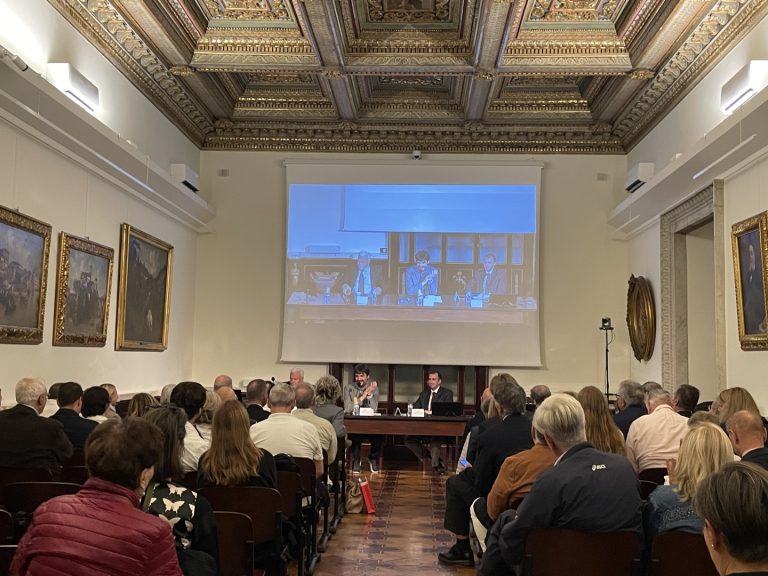
Rome, 13 October 2026 — A turning point in the study of the Order of the Temple: the international conference “The Templars and the Vox in excelso: a historical error?” took place at the Fondazione Ernesta Besso in Rome, devoted to the 1312 bull that most historians regard as the act suppressing the Order.
The meeting was moderated by Mario Ascheri (Università Roma Tre). The speakers were Johannes Michael Rainer (Universität Salzburg), who introduced the author and the interdisciplinary project on the Templars launched in Salzburg, and Daniele Mattiangeli (Universität Salzburg), author of the study Una interpretazione giuridica dei differenti testi della presunta bolla papale Vox in excelso del 1312 (Aracne, 2025). The Templars Today were represented by the Magister Mauro Giorgio Ferretti.
The technical picture: history, sources, law
- No original. The original of the Vox in excelso has never been documented. Only copies and transcriptions exist, preserved or published in different places: the Barcelona copy, the manuscript of Jacques de Thérines (present at the Council of Vienne) in Dijon, and the editions of Labbé (1671), Mansi (1782) and Villanueva (1806). The Barcelona copy is the only one that can be identified with certainty, but because of its dating it cannot be the original.
- Sources to be checked. In his Viage literario (1806), Villanueva did not have the original bull before his eyes: the text he reports is not the original and most likely derives from the Barcelona text.
- Texts that do not match. About two hundred differences were found among the classic versions, concentrated in just a few pages of text: that is where the anomaly lies. The text of the Vox in excelso accepted in the official collection of conciliar decrees is Villanueva’s, not Barcelona’s, and in the strictly legal part the two texts diverge in 33 points. According to Mattiangeli these are not simple transcription errors or the alterations typical of Latin epigraphy: the inconsistencies concern content, not grammar.
- An anomalous curse. The text contains a “strange curse” by Clement V, which the speakers consider improbable for a pontiff.
- The bull that produced effects: Ad providam. Witnesses at the Council of Vienne, such as Walter of Guisborough, cite precisely the transfer of the Templar assets to the Hospitallers. The bull Nuper in concilio (1312) transmits the provisions of Ad providam to the sovereigns, and at Klosterneuburg in Austria a transfer of church property took place on the basis of that very bull, dated 2 May 1312, after lengthy deliberation. That the Vox in excelso could have been issued before the end of the Council is, according to the speaker, impossible.
- The legal crux. A bull alone is not enough to transfer assets: a legal act is required. With an original never documented and reported only in different and anomalous versions, the Vox in excelso is in effect a historical forgery, with legal consequences both ancient and modern.
The question of the Magister Ferretti
During the discussion the Magister Mauro Giorgio Ferretti asked two questions: why this fear on the part of the Church? And why not rehabilitate the Order, out of respect for the memory of the ancient Fratres, for that reason alone and not for the assets?
Mattiangeli replied that the concern relates to the current ownership of the assets, which, if the Vox in excelso were a forgery, would revert to the Church, with separate questions of usucapion (acquisitive prescription) concerning the Order of Malta: a purely legal matter, he specified.
Our goal: to rehabilitate the honour of the Templars
The Processus contra Templarios ended with absolution, documented by the Chinon Parchment. For this reason, as an association, we ask the Holy Father for the moral and historical recognition of the honour of the ancient Templars, who were accused on the basis of confessions extracted under torture and remained faithful to the Apostolic See. If the Pontiff so wished, new possibilities of rehabilitation would open up: an act of historical justice that only a particularly courageous Pope could accomplish.
This request concerns exclusively Faith and Memory: not the reconstitution of the Order, nor the restitution of assets. It confirms what we have always maintained, as already written in our in-depth article The Vox in excelso bull.
We thank the speakers, the Fondazione Ernesta Besso and the academic world for the rigour with which they have restored factual, verifiable clarity to a fundamental page of history.


